Buy jean-lucdehaene.eu ?
We are moving the project
jean-lucdehaene.eu .
Are you interested in purchasing the domain
jean-lucdehaene.eu ?
domain@kv-gmbh.de · 0541-91531010
Buy jean-lucdehaene.eu ?
What is easier: Business Administration, Economics, or Economics and Business Administration?
The ease of studying Business Administration, Economics, or Economics and Business Administration can vary depending on individual strengths and interests. Business Administration typically focuses on management, marketing, and finance, while Economics delves into the study of production, distribution, and consumption of goods and services. Economics and Business Administration combines elements of both fields. Some may find Business Administration easier due to its practical and hands-on approach, while others may find Economics easier due to its focus on theory and analysis. Ultimately, the ease of studying these subjects depends on the individual's strengths and interests. **
What is the manuscript submission policy of Random House publishers?
Random House does not accept unsolicited manuscripts, meaning they only consider submissions from literary agents. Authors are encouraged to find representation before submitting their work to Random House. This policy helps ensure that submissions are of a certain quality and have been vetted by professionals in the industry. **
![Wiley/Random House Business The 10X Rule [HB] & Atomic Habits [PB] – 2 Books Collection Set by Grant Cardone & James Clear Success, Productivity & Personal Development Books](https://cdn.adindex.com/oimg/63d96256-dfef-45aa-afb3-20cc70346fe3)
Similar search terms for Wiley-Random-House-Business
Top-Angebote
Products related to Wiley-Random-House-Business:
-
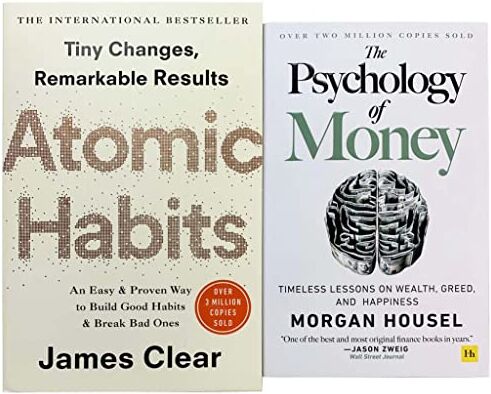
Random House Business/Harriman House ltd Atomic Habits & The Psychology of Money – 2 Books Collection Set Personal Growth, Wealth & Mindset BestsellersAtomic Habits People think that when you want to change your life, you need to think big. But world-renowned habits expert James Clear has discovered another way. He knows that real change comes from the compound effect of hundreds of small decisions: doing two push-ups a day, waking up five minutes early, or holding a single short phone call. He calls them atomic habits. In this ground-breaking book, Clears reveals exactly how these minuscule changes can grow into such life-altering outcomes. He uncovers a handful of simple life hacks (the forgotten art of Habit Stacking, the unexpected power of the Two Minute Rule, or the trick to entering the Goldilocks Zone), and delves into cutting-edge psychology and neuroscience to explain why they matter. Along the way, he tells inspiring stories of Olympic gold medalists, leading CEOs, and distinguished scientists who have used the science of tiny habits to stay productive, motivated, and happy. The Psychology of Money Doing well with money isn't necessarily about what you know. It's about how you behave. And behaviour is hard to teach, even to really smart people. Money investing, personal finance, and business decisions is typically taught as a math-based field, where data and formulas tell us exactly what to do. But in the real world people don't make financial decisions on a spreadsheet. They make them at the dinner table, or in a meeting room, where personal history, your own unique view of the world, ego, pride, marketing, and odd incentives are scrambled together. In The Psychology of Money, award-winning author Morgan Housel shares 19 short stories exploring the strange ways people think about money and teaches you how to make better sense of one of life's most important topics.15,99 £*Shipping: 2,99 £Secure redirect to the provider
-
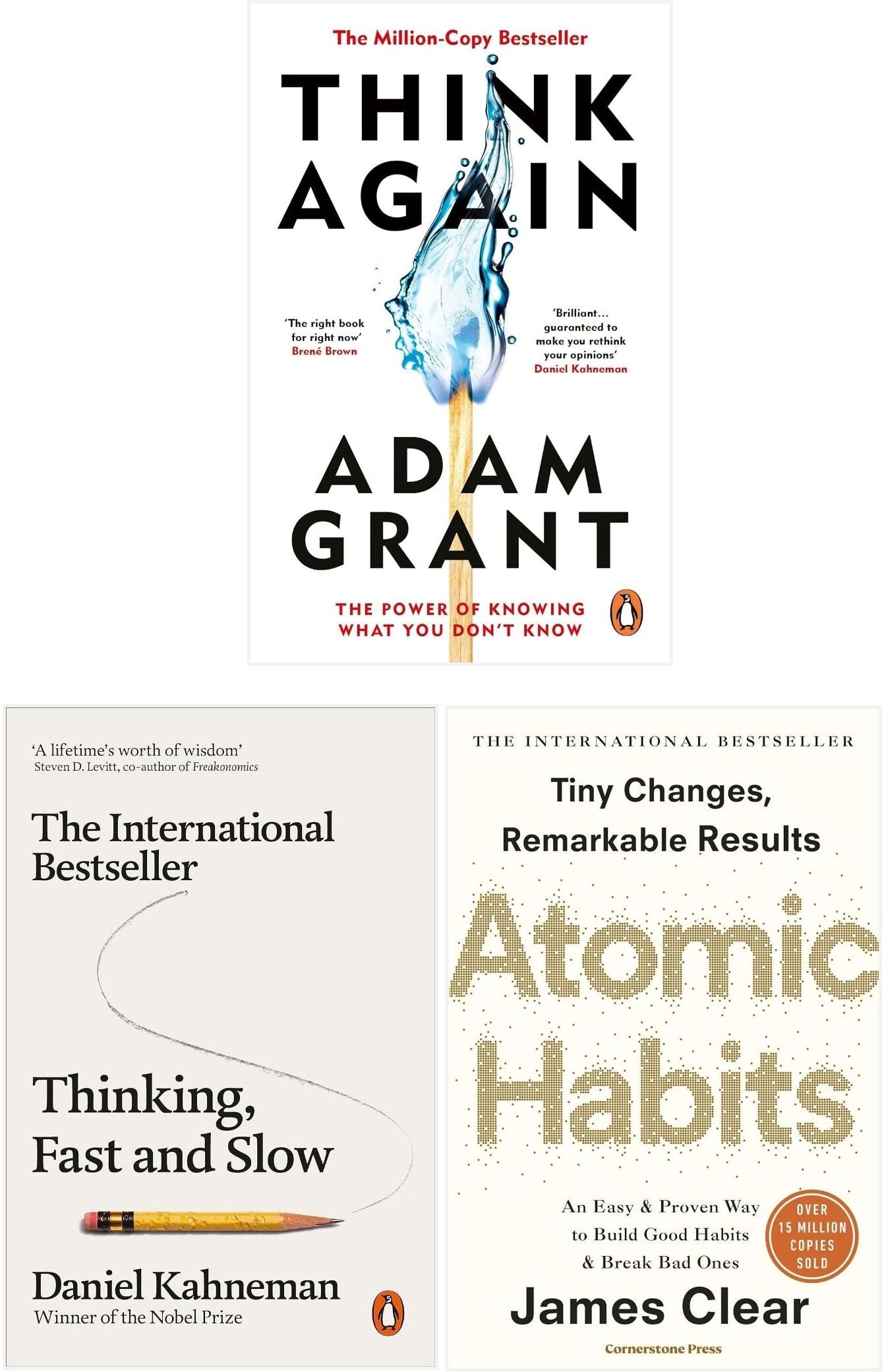
WH Allen/Random House Business/Penguin Think Again, Atomic Habits and Thinking, Fast and Slow 3 Books Collection SetThink Again by Adam Grant If you can change your mind you can do anything. Why do we refresh our wardrobes every year, renovate our kitchens every decade, but never update our beliefs and our views? Why do we laugh at people using computers that are ten years old, but yet still cling to opinions we formed ten years ago? There's a new skill for the modern world that matters more than raw intelligence - the ability to change your mind. To have the edge we all need to develop the flexibility to unlearn old beliefs and adapt when the evidence and the world changes before us. Atomic Habits by James Clear Transform your life with tiny changes in behaviour, starting now. People think that when you want to change your life, you need to think big. But world-renowned habits expert James Clear has discovered another way. He knows that real change comes from the compound effect of hundreds of small decisions: doing two push-ups a day, waking up five minutes early, or holding a single short phone call. He calls them atomic habits. Thinking, Fast and Slow by Daniel Kahneman Why do we make the decisions we do? Nobel Prize winner Daniel Kahneman revolutionised our understanding of human behaviour with Thinking, Fast and Slow. Distilling his life's work, Kahneman showed that there are two ways we make choices: fast, intuitive thinking, and slow, rational thinking. His book reveals how our minds are tripped up by error, bias and prejudice (even when we think we are being logical) and gives practical techniques that enable us all to improve our decision-making. This profound exploration of the marvels and limitations of the human mind has had a lasting impact on how we see ourselves.22,99 £*Shipping: 2,99 £Secure redirect to the provider
-
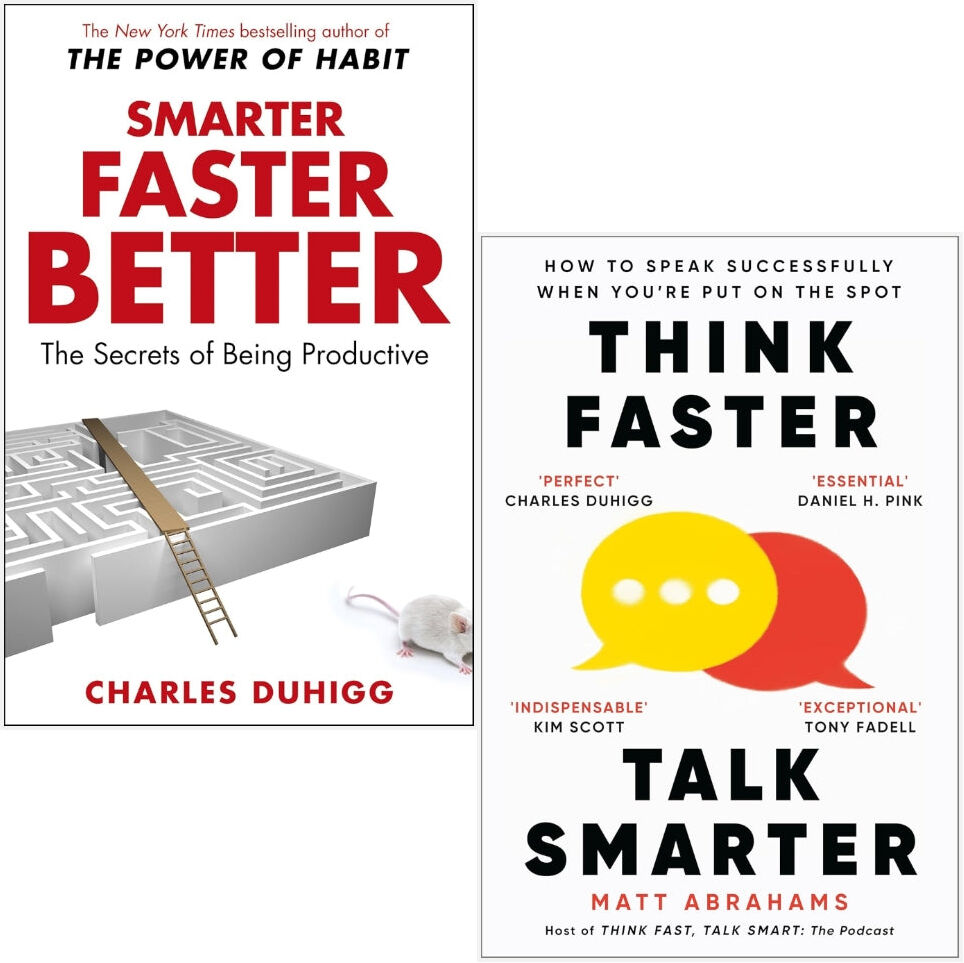
Random House Books/Macmillan Business Smarter Faster Better by Charles Duhigg and Think Faster, Talk Smarter by Matt Abrahams 2 Books SetSmarter Faster Better by Charles Duhigg Drawing on the very latest findings in neuroscience, psychology and behavioural economics, he demonstrates the eight simple principles that govern productivity. He demonstrates how the most dynamic and effective people – from CEOs to film-makers to software entrepreneurs – deploy them. And he shows how you can, too. Think Faster, Talk Smarter by Matt Abrahams Communication is crucial to success in life and business. However, it is not just big speeches that matter: it is also those critical, spur-of-the-moment situations for which we cannot prepare. A prospective client asking unexpected questions during a sales pitch, a teacher singling you out for an answer during a class, a high-pressure meeting with senior executives at work, or even a heartwarming toast to deliver on the spot. All are fraught scenarios that might cause you to freeze up. The pandemic boosted this fear, by stripping the spontaneity from communication during lockdown, and then changing the communication landscape in the years since.11,99 £*Shipping: 2,99 £Secure redirect to the provider
-
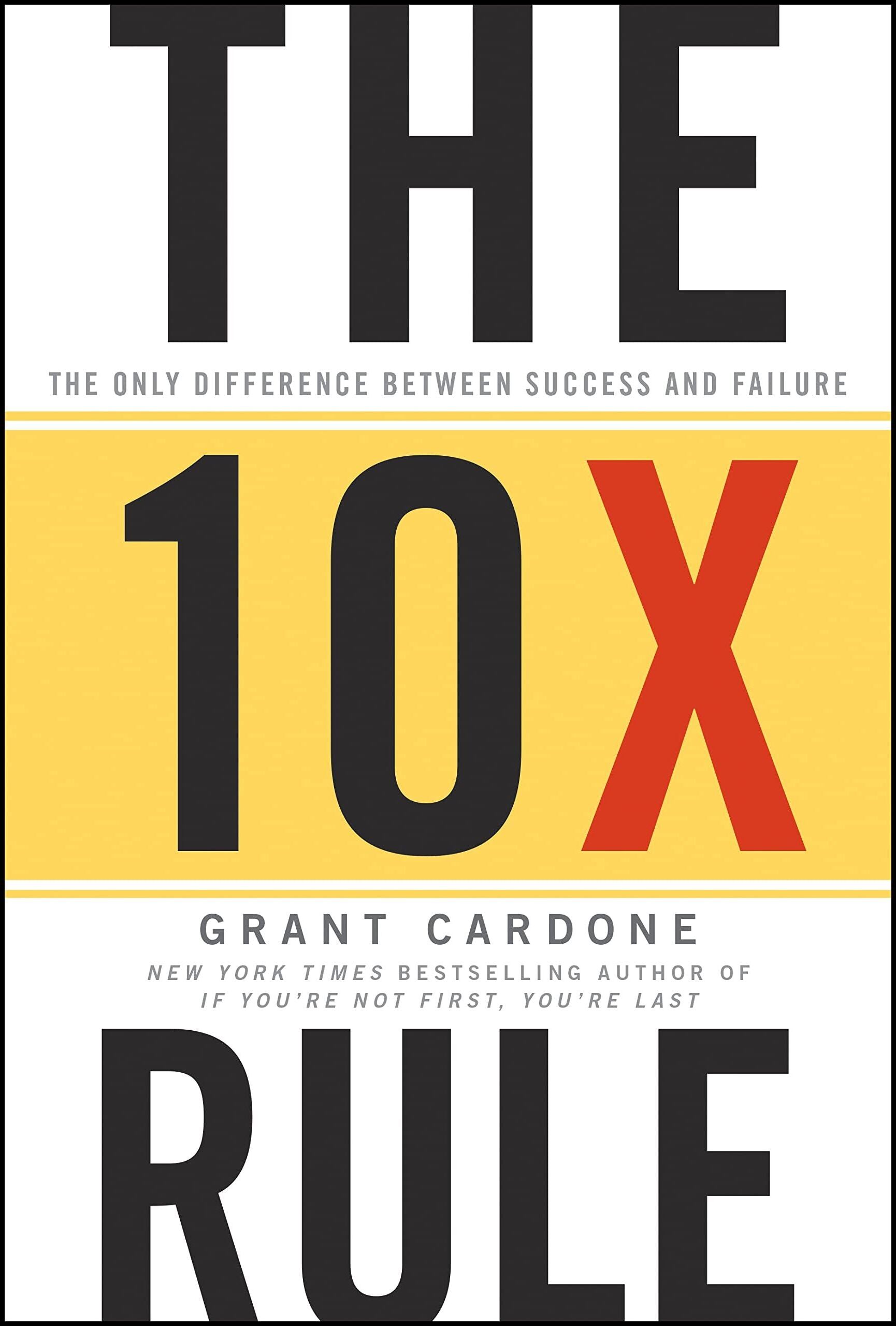
Wiley The 10X Rule: The Only Difference Between Success and Failure by Grant Cardone Motivation, Business & Self-Improvement BestsellerAchieve "Massive Action" results and accomplish your business dreams! While most people operate with only three degrees of action-no action, retreat, or normal action-if you're after big goals, you don't want to settle for the ordinary. To reach the next level, you must understand the coveted 4th degree of action. This 4th degree, also know as the 10 X Rule, is that level of action that guarantees companies and individuals realize their goals and dreams. The 10 X Rule unveils the principle of "Massive Action," allowing you to blast through business clichés and risk-aversion while taking concrete steps to reach your dreams. It also demonstrates why people get stuck in the first three actions and how to move into making the 10X Rule a discipline. Find out exactly where to start, what to do, and how to follow up each action you take with more action to achieve Massive Action results. Learn the "Estimation of Effort" calculation to ensure you exceed your targets Make the Fourth Degree a way of life and defy mediocrity Discover the time management myth Get the exact reasons why people fail and others succeed Know the exact formula to solve problems Extreme success is by definition outside the realm of normal action. Instead of behaving like everybody else and settling for average results, take Massive Action with The 10 X Rule, remove luck and chance from your business equation, and lock in massive success.15,99 £*Shipping: 2,99 £Secure redirect to the provider
-
What is the manuscript submission process for Random House publishers?
The manuscript submission process for Random House publishers typically involves sending a query letter or proposal to the appropriate editor or literary agent. If the editor or agent is interested, they may request to see the full manuscript. Once the manuscript is submitted, it will go through a review process to determine if it aligns with the publisher's needs and standards. If the manuscript is accepted, the author will work with an editor to prepare the book for publication. **
-
Which field do you prefer: Business Mathematics or Business Economics?
I prefer Business Mathematics because I enjoy working with numbers and solving complex mathematical problems. I find the quantitative analysis and statistical modeling in Business Mathematics to be intellectually stimulating and applicable to a wide range of business scenarios. Additionally, I believe that a strong foundation in mathematics provides a valuable skill set for making informed business decisions and understanding financial data. **
-
Is economics or business administration easier?
The difficulty of economics versus business administration can vary depending on individual strengths and interests. Economics typically involves more theoretical concepts and mathematical analysis, while business administration focuses more on practical applications and management skills. Some may find economics more challenging due to its focus on complex economic theories and models, while others may find business administration more difficult because of its emphasis on decision-making and leadership. Ultimately, the perceived difficulty of each subject will depend on the individual's background, interests, and learning style. **
-
Is business economics exactly the same as business administration or management?
Business economics and business administration or management are related but not exactly the same. Business economics focuses on the application of economic theories and principles to analyze business decisions, market trends, and financial strategies. On the other hand, business administration or management involves overseeing the operations, resources, and people within an organization to achieve its goals and objectives. While both fields are interconnected and essential for running a successful business, they have distinct focuses and areas of expertise. **


What is the difference between Business Administration (BWL) and Business and Economics?
Business Administration (BWL) typically focuses on the management and administration of businesses, including topics such as organizational behavior, marketing, and finance. On the other hand, Business and Economics combines business studies with a broader understanding of economic principles and theories. This program often includes courses in micro and macroeconomics, econometrics, and economic policy analysis, providing students with a more in-depth understanding of the economic factors that influence business decisions. Overall, while Business Administration (BWL) is more focused on the practical aspects of running a business, Business and Economics offers a more theoretical and analytical approach that incorporates economic perspectives. **
What is the difference between Business Administration (BWL) and Business Economics (BWR)?
Business Administration (BWL) focuses on the practical aspects of managing businesses, such as organizational structures, human resources, marketing, and finance. On the other hand, Business Economics (BWR) emphasizes the theoretical and analytical aspects of business decision-making, including economic theories, market structures, and strategic planning. While BWL is more hands-on and application-oriented, BWR is more theoretical and research-oriented. Both fields are essential in understanding and managing businesses effectively. **
Top-Angebote
Products related to Wiley-Random-House-Business:
-
Wiley/Random House Business The 10X Rule [HB] & Atomic Habits [PB] – 2 Books Collection Set by Grant Cardone & James Clear Success, Productivity & Personal Development BooksUpgrade your mindset, habits, and results with The 10X Rule and Atomic Habits – 2 Books Collection Set by Grant Cardone and James Clear. This powerful self-development bundle combines two of the most influential personal growth books of all time. In The 10X Rule, Grant Cardone teaches you how to take massive action, think bigger, and achieve extraordinary success in business and life. Atomic Habits by James Clear reveals how small, consistent habit changes can lead to remarkable long-term improvement. Together, these books provide a complete system for high performance, productivity, goal achievement, and personal transformation—helping you build the habits and mindset needed to succeed. The 10X Rule [Hardcover] Achieve "Massive Action" results and accomplish your business dreams! While most people operate with only three degrees of action-no action, retreat, or normal action-if you're after big goals, you don't want to settle for the ordinary. To reach the next level, you must understand the coveted 4th degree of action. This 4th degree, also know as the 10 X Rule, is that level of action that guarantees companies and individuals realize their goals and dreams. The 10 X Rule unveils the principle of "Massive Action," allowing you to blast through business clichés and risk-aversion while taking concrete steps to reach your dreams. It also demonstrates why people get stuck in the first three actions and how to move into making the 10X Rule a discipline. Find out exactly where to start, what to do, and how to follow up each action you take with more action to achieve Massive Action results. Atomic Habits [Paperback] Transform your life with tiny changes in behaviour, starting now. People think that when you want to change your life, you need to think big. But world-renowned habits expert James Clear has discovered another way. He knows that real change comes from the compound effect of hundreds of small decisions: doing two push-ups a day, waking up five minutes early, or holding a single short phone call. He calls them atomic habits.25,99 £*Shipping: 2,99 £Secure redirect to the provider
-
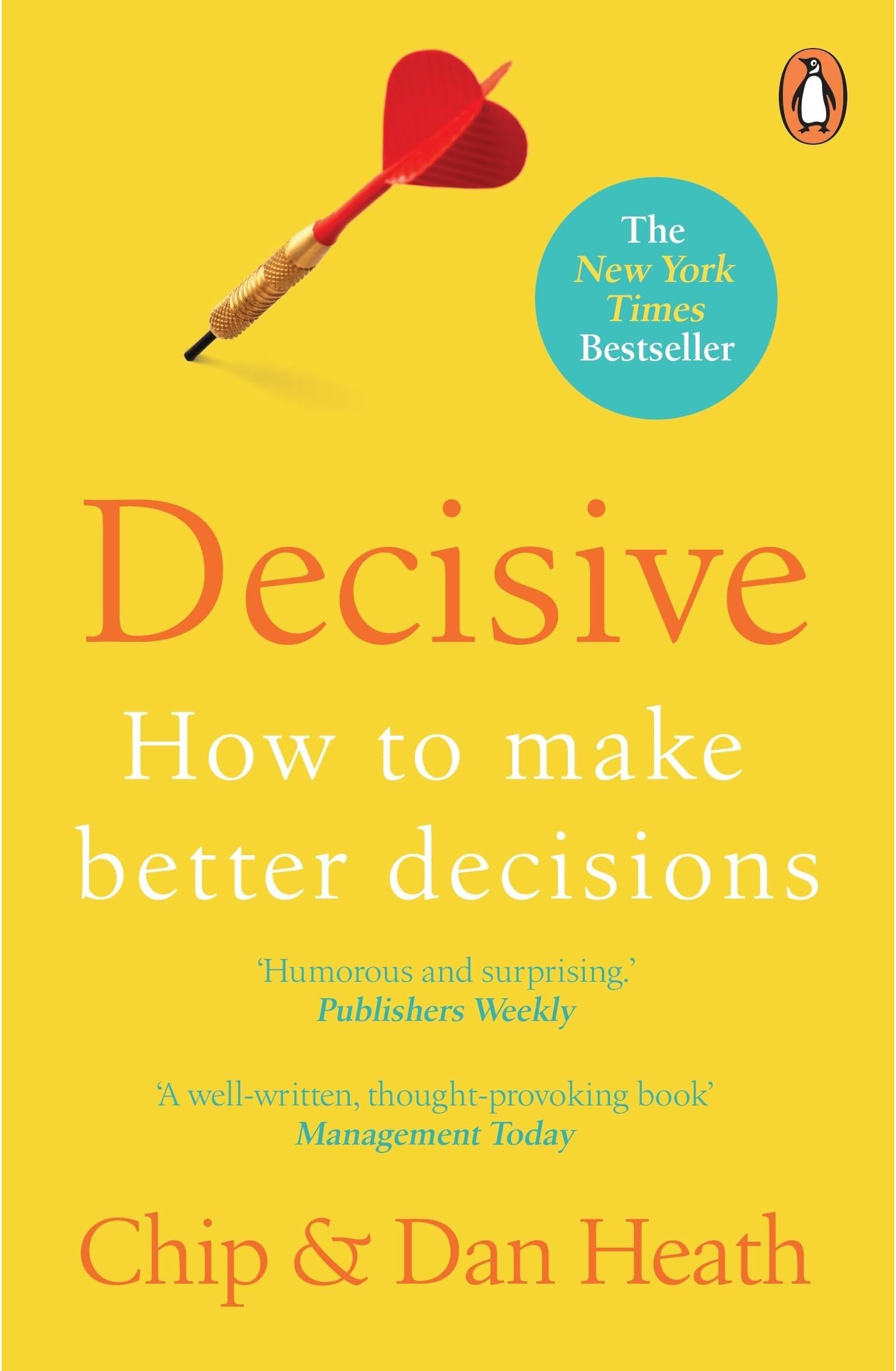
Random House Business Decisive: How to Make Better Decisions by Chip & Dan HeathThe New York Times-bestselling authors of Switch and Made to Stick offer a fascinating tour through the workings of our minds to reveal how to make smarter decisions. Research in psychology has revealed that our decisions are disrupted by an array of biases and irrationalities. We're overconfident. We seek out information that supports us and downplay information that doesn't. We get distracted by short-term emotions. When it comes to making choices, our brains are flawed instruments. So, how can we do better? In Decisive, Chip and Dan Heath draw on cutting-edge psychological research to introduce a four-step process designed to counteract these biases. They reveal how we can stop the cycle of agonizing over our decisions, how can we make group decisions without destructive politics, and how to ensure that we don't overlook precious opportunities to change our course. Along the way, they demonstrate how relatively easy it is to avoid the pitfalls and find the best answers. Written in a compulsively readable style, Decisive takes us on a tour from a rock star's ingenious decision-making trick, to a CEO's disastrous acquisition, to a single question that can often resolve thorny personal decisions, in order to offer fresh strategies and practical tools that will enable you to make better choices. Because the right decision, at the right moment, can make all the difference.9,99 £*Shipping: 2,99 £Secure redirect to the provider
-
Random House Business/Harriman House ltd Atomic Habits & The Psychology of Money – 2 Books Collection Set Personal Growth, Wealth & Mindset BestsellersAtomic Habits People think that when you want to change your life, you need to think big. But world-renowned habits expert James Clear has discovered another way. He knows that real change comes from the compound effect of hundreds of small decisions: doing two push-ups a day, waking up five minutes early, or holding a single short phone call. He calls them atomic habits. In this ground-breaking book, Clears reveals exactly how these minuscule changes can grow into such life-altering outcomes. He uncovers a handful of simple life hacks (the forgotten art of Habit Stacking, the unexpected power of the Two Minute Rule, or the trick to entering the Goldilocks Zone), and delves into cutting-edge psychology and neuroscience to explain why they matter. Along the way, he tells inspiring stories of Olympic gold medalists, leading CEOs, and distinguished scientists who have used the science of tiny habits to stay productive, motivated, and happy. The Psychology of Money Doing well with money isn't necessarily about what you know. It's about how you behave. And behaviour is hard to teach, even to really smart people. Money investing, personal finance, and business decisions is typically taught as a math-based field, where data and formulas tell us exactly what to do. But in the real world people don't make financial decisions on a spreadsheet. They make them at the dinner table, or in a meeting room, where personal history, your own unique view of the world, ego, pride, marketing, and odd incentives are scrambled together. In The Psychology of Money, award-winning author Morgan Housel shares 19 short stories exploring the strange ways people think about money and teaches you how to make better sense of one of life's most important topics.15,99 £*Shipping: 2,99 £Secure redirect to the provider
-
WH Allen/Random House Business/Penguin Think Again, Atomic Habits and Thinking, Fast and Slow 3 Books Collection SetThink Again by Adam Grant If you can change your mind you can do anything. Why do we refresh our wardrobes every year, renovate our kitchens every decade, but never update our beliefs and our views? Why do we laugh at people using computers that are ten years old, but yet still cling to opinions we formed ten years ago? There's a new skill for the modern world that matters more than raw intelligence - the ability to change your mind. To have the edge we all need to develop the flexibility to unlearn old beliefs and adapt when the evidence and the world changes before us. Atomic Habits by James Clear Transform your life with tiny changes in behaviour, starting now. People think that when you want to change your life, you need to think big. But world-renowned habits expert James Clear has discovered another way. He knows that real change comes from the compound effect of hundreds of small decisions: doing two push-ups a day, waking up five minutes early, or holding a single short phone call. He calls them atomic habits. Thinking, Fast and Slow by Daniel Kahneman Why do we make the decisions we do? Nobel Prize winner Daniel Kahneman revolutionised our understanding of human behaviour with Thinking, Fast and Slow. Distilling his life's work, Kahneman showed that there are two ways we make choices: fast, intuitive thinking, and slow, rational thinking. His book reveals how our minds are tripped up by error, bias and prejudice (even when we think we are being logical) and gives practical techniques that enable us all to improve our decision-making. This profound exploration of the marvels and limitations of the human mind has had a lasting impact on how we see ourselves.22,99 £*Shipping: 2,99 £Secure redirect to the provider
-
What is easier: Business Administration, Economics, or Economics and Business Administration?
The ease of studying Business Administration, Economics, or Economics and Business Administration can vary depending on individual strengths and interests. Business Administration typically focuses on management, marketing, and finance, while Economics delves into the study of production, distribution, and consumption of goods and services. Economics and Business Administration combines elements of both fields. Some may find Business Administration easier due to its practical and hands-on approach, while others may find Economics easier due to its focus on theory and analysis. Ultimately, the ease of studying these subjects depends on the individual's strengths and interests. **
-
What is the manuscript submission policy of Random House publishers?
Random House does not accept unsolicited manuscripts, meaning they only consider submissions from literary agents. Authors are encouraged to find representation before submitting their work to Random House. This policy helps ensure that submissions are of a certain quality and have been vetted by professionals in the industry. **
-
What is the manuscript submission process for Random House publishers?
The manuscript submission process for Random House publishers typically involves sending a query letter or proposal to the appropriate editor or literary agent. If the editor or agent is interested, they may request to see the full manuscript. Once the manuscript is submitted, it will go through a review process to determine if it aligns with the publisher's needs and standards. If the manuscript is accepted, the author will work with an editor to prepare the book for publication. **
-
Which field do you prefer: Business Mathematics or Business Economics?
I prefer Business Mathematics because I enjoy working with numbers and solving complex mathematical problems. I find the quantitative analysis and statistical modeling in Business Mathematics to be intellectually stimulating and applicable to a wide range of business scenarios. Additionally, I believe that a strong foundation in mathematics provides a valuable skill set for making informed business decisions and understanding financial data. **
Similar search terms for Wiley-Random-House-Business
-
Random House Books/Macmillan Business Smarter Faster Better by Charles Duhigg and Think Faster, Talk Smarter by Matt Abrahams 2 Books SetSmarter Faster Better by Charles Duhigg Drawing on the very latest findings in neuroscience, psychology and behavioural economics, he demonstrates the eight simple principles that govern productivity. He demonstrates how the most dynamic and effective people – from CEOs to film-makers to software entrepreneurs – deploy them. And he shows how you can, too. Think Faster, Talk Smarter by Matt Abrahams Communication is crucial to success in life and business. However, it is not just big speeches that matter: it is also those critical, spur-of-the-moment situations for which we cannot prepare. A prospective client asking unexpected questions during a sales pitch, a teacher singling you out for an answer during a class, a high-pressure meeting with senior executives at work, or even a heartwarming toast to deliver on the spot. All are fraught scenarios that might cause you to freeze up. The pandemic boosted this fear, by stripping the spontaneity from communication during lockdown, and then changing the communication landscape in the years since.11,99 £*Shipping: 2,99 £Secure redirect to the provider
-
Wiley The 10X Rule: The Only Difference Between Success and Failure by Grant Cardone Motivation, Business & Self-Improvement BestsellerAchieve "Massive Action" results and accomplish your business dreams! While most people operate with only three degrees of action-no action, retreat, or normal action-if you're after big goals, you don't want to settle for the ordinary. To reach the next level, you must understand the coveted 4th degree of action. This 4th degree, also know as the 10 X Rule, is that level of action that guarantees companies and individuals realize their goals and dreams. The 10 X Rule unveils the principle of "Massive Action," allowing you to blast through business clichés and risk-aversion while taking concrete steps to reach your dreams. It also demonstrates why people get stuck in the first three actions and how to move into making the 10X Rule a discipline. Find out exactly where to start, what to do, and how to follow up each action you take with more action to achieve Massive Action results. Learn the "Estimation of Effort" calculation to ensure you exceed your targets Make the Fourth Degree a way of life and defy mediocrity Discover the time management myth Get the exact reasons why people fail and others succeed Know the exact formula to solve problems Extreme success is by definition outside the realm of normal action. Instead of behaving like everybody else and settling for average results, take Massive Action with The 10 X Rule, remove luck and chance from your business equation, and lock in massive success.15,99 £*Shipping: 2,99 £Secure redirect to the provider
-
Random House Books The Undercover Economist by Tim Harford"The economy [isn't] a bunch of rather dull statistics with names like GDP (gross domestic product)," notes Tim Harford, columnist and regular guest on NPR's Marketplace, "economics is about who gets what and why." In this acclaimed and riveting book-part exposé, part user's manual-the astute and entertaining columnist from the Financial Times demystifies the ways in which money works in the world. From why the coffee in your cup costs so much to why efficiency is not necessarily the answer to ensuring a fair society, from improving health care to curing crosstown traffic-all the dirty little secrets of dollars and cents are delightfully revealed by The Undercover Economist.4,99 £*Shipping: 1,99 £Secure redirect to the provider
-
Random House Business/Canongate Books ltd Atomic Habits By James Clear and If I Could Tell You Just One Thing By Richard Reed 2 Books Collection SetAtomic Habits By James Clear & If I Could Tell You Just One Thing By Richard Reed 2 Books Collection Set: Atomic Habits: In this ground-breaking book, Clears reveals exactly how these minuscule changes can grow into such life-altering outcomes. He uncovers a handful of simple life hacks (the forgotten art of Habit Stacking, the unexpected power of the Two Minute Rule, or the trick to entering the Goldilocks Zone), and delves into cutting-edge psychology and neuroscience to explain why they matter. Along the way, he tells inspiring stories of Olympic gold medalists, leading CEOs, and distinguished scientists who have used the science of tiny habits to stay productive, motivated, and happy. If I Could Tell You Just One Thing: In If I Could Tell You Just One Thing... some of the world's most remarkable people share their most valuable pieces of wisdom.Including: President Bill Clinton, Clare Balding, Bill Gates, Stephen Fry, Dame Judi Dench, His Holiness the Dalai Lama, Caitlyn Jenner, James Corden, Margaret Atwood, Sir David Attenborough, Annie Lennox, Andy Murray, Joanna Lumley, Sir Richard Branson, Sandi Toksvig, Jude Law, Nicola Sturgeon, Harry Belafonte, Olivia Colman, Simon Cowell, Bear Grylls, Diana Athill, Jo Malone, Heston Blumenthal, Nitin Sawhney, Katie Piper, Richard Curtis, Shami Chakrabarti, and Michael McIntyre.If I Could Tell You Just One Thing... is not only packed with great advice but is also enormously entertaining, brilliantly written and stunningly designed. From advice on work and relationships, to creativity, spirituality and survival, there are words in these pages that will comfort, motivate and inspire.21,99 £*Shipping: 2,99 £Secure redirect to the provider
-
Is economics or business administration easier?
The difficulty of economics versus business administration can vary depending on individual strengths and interests. Economics typically involves more theoretical concepts and mathematical analysis, while business administration focuses more on practical applications and management skills. Some may find economics more challenging due to its focus on complex economic theories and models, while others may find business administration more difficult because of its emphasis on decision-making and leadership. Ultimately, the perceived difficulty of each subject will depend on the individual's background, interests, and learning style. **
-
Is business economics exactly the same as business administration or management?
Business economics and business administration or management are related but not exactly the same. Business economics focuses on the application of economic theories and principles to analyze business decisions, market trends, and financial strategies. On the other hand, business administration or management involves overseeing the operations, resources, and people within an organization to achieve its goals and objectives. While both fields are interconnected and essential for running a successful business, they have distinct focuses and areas of expertise. **
-
What is the difference between Business Administration (BWL) and Business and Economics?
Business Administration (BWL) typically focuses on the management and administration of businesses, including topics such as organizational behavior, marketing, and finance. On the other hand, Business and Economics combines business studies with a broader understanding of economic principles and theories. This program often includes courses in micro and macroeconomics, econometrics, and economic policy analysis, providing students with a more in-depth understanding of the economic factors that influence business decisions. Overall, while Business Administration (BWL) is more focused on the practical aspects of running a business, Business and Economics offers a more theoretical and analytical approach that incorporates economic perspectives. **
-
What is the difference between Business Administration (BWL) and Business Economics (BWR)?
Business Administration (BWL) focuses on the practical aspects of managing businesses, such as organizational structures, human resources, marketing, and finance. On the other hand, Business Economics (BWR) emphasizes the theoretical and analytical aspects of business decision-making, including economic theories, market structures, and strategic planning. While BWL is more hands-on and application-oriented, BWR is more theoretical and research-oriented. Both fields are essential in understanding and managing businesses effectively. **
* All prices are inclusive of VAT and, if applicable, plus shipping costs. The offer information is based on the details provided by the respective shop and is updated through automated processes. Real-time updates do not occur, so deviations can occur in individual cases. ** Note: Parts of this content were created by AI.