Buy jean-lucdehaene.eu ?
We are moving the project
jean-lucdehaene.eu .
Are you interested in purchasing the domain
jean-lucdehaene.eu ?
domain@kv-gmbh.de · 0541-91531010
Buy jean-lucdehaene.eu ?
What is inertia?
Inertia is the tendency of an object to resist changes in its state of motion. This means that an object at rest will stay at rest, and an object in motion will stay in motion at a constant velocity unless acted upon by an external force. The greater the mass of an object, the greater its inertia, making it harder to change its motion. **
What is the concept of inertia force and inertia moment?
Inertia force is a fictitious force that appears in a non-inertial reference frame to account for the acceleration of an object. It is equal in magnitude and opposite in direction to the force causing the acceleration. Inertia moment, on the other hand, is the tendency of a rotating body to resist changes in its rotational motion. It is similar to inertia force but applies to rotational motion instead of linear motion. Both concepts are important in understanding the behavior of objects in motion. **


Similar search terms for Inertia
Top-Angebote
Products related to Inertia:
-
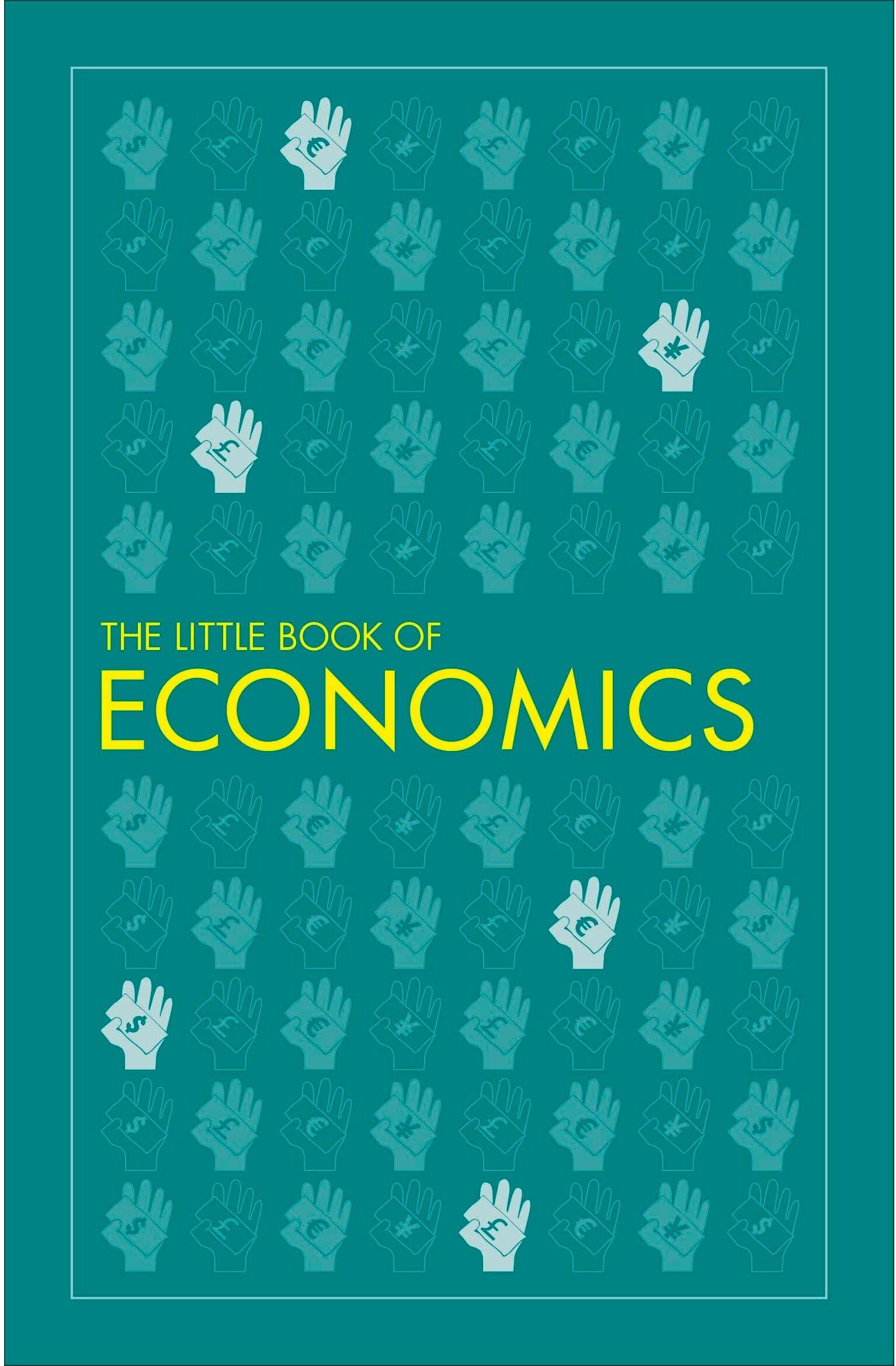
The Little Book of Economics (DK Big Ideas Series)This book is the perfect introduction to the subject of economics and economic ideas through history. From the earliest forms of currency to the Industrial Revolution, and from the birth of the stock market to free-market capitalism and globalized trade, The Little Book of Economics brings economic theory and the work of key economists to life. Journeying through centuries of economic thought, it is the perfect pocket-sized guide to the subject. Packed with infographics and flowcharts that explain complex concepts clearly and simply, The Little Book of Economics offers you a combination of clear text and hard-working infographics in a portable format that is perfect for reading on the go.5,99 £*Shipping: 2,99 £Secure redirect to the provider
-
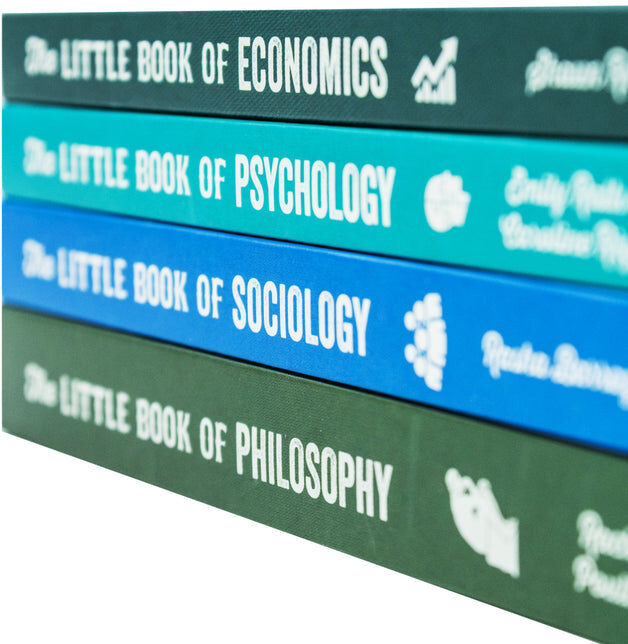
Summersdale Publishers The Little Book of Philosophy, Sociology, Economics & Psychology 4 Books Collection SetThe Little Book of Philosophy Philosophy is a quest for wisdom and knowledge; philosophia in Ancient Greek literally means “love of wisdom”. The aim of philosophy is to ask and explore life’s big questions to help us work out what we can know and how we can live a good life. Today, in a world of fake news, embarking on a quest for truth couldn’t be more important. The Little Book of Sociology From the smallest everyday interaction to the impact of vast systemic change, societies are brimming with fascinating phenomena we all want to understand more clearly.There's never been a more important moment to grasp what's going on around us, and this pocket-sized guide offers an engaging introduction to the key sociological concepts. The Little Book of Economics This Book will bring you up to speed on the basics of micro- and macroeconomics and demystify the world of taxes, trade, investments and finance, in simple English and with easy-to-follow examples.By the end of this crash course, you will have a grasp on all the essential terms, concepts and theories you need to know to understand modern-day. The Little Book of Psychology If you want to know your Freud from your Jung and your Milgram from your Maslow, strap in for this whirlwind tour of the highlights of psychology. Including accessible primers on: - The early thinkers who contributed to psychological ideas and the birth of modern psychology- Famous (and often controversial) experiments and their repercussions.12,99 £*Shipping: 2,99 £Secure redirect to the provider
-
DK The Little Book Of Series 6 Books Collection Set (Economics, Politics, Shakespeare, Philosophy, Psychology, History)The Little Book Of Economics From the earliest forms of currency to the Industrial Revolution, and from the birth of the stock market to free-market capitalism and globalized trade, The Little Book of Economics brings economic theory and the work of key economists to life. Journeying through centuries of economic thought, it is the perfect pocket-sized guide to the subject. The Little Book Of Politics From the origins of democracy to Machiavelli's cunning statecraft, and from Rousseau's "social contract" to the American Declaration of Independence, Marxist communism, the dawn of populism, and identity politics, The Little Book of Politics examines the philosophies behind the different political beliefs and methods of government used around the world over the course of human history. The Little Book Of Shakespeare This bold book covers every work, from the comedies of Twelfth Night and As You Like It to the tragedies of Julius Caesar and Hamlet, plus lost plays and less well-known works of poetry. Easy-to-understand graphics and illustrations bring the themes, plots, characters and language of Shakespeare to life, including illustrated timelines which offer an at-a-glance summary of the action for each play. With detailed plot summaries and an in-depth analysis of the major characters and themes, this is a brilliant, innovative exploration of the entire canon of Shakespeare plays, sonnets and poetry. The Little Book Of Philosophy To the complete novice learning about philosophy can be daunting - The Little Book of Philosophy changes all that. With the use of powerful and easy-to-follow images, famous quotations, and explanations that are easily understandable, this book cuts through any misunderstandings to demystify the subject. The Little Book Of Psychology DK's The Little Book of Psychology answers all these questions and provides an insight into this fascinating field of science. Whether you are a student, an expert, a novice, or have a general interest in the human mind, this portable guide is the perfect choice to start exploring and understanding psychology. The Little Book Of History The Little Book of History charts world history from the dawn of civilisation to the modern culture we live in today. From the origins of homo-sapiens to the release of Nelson Mandela, from the French Revolution to the Space Race, The Little Book of History is a stunning exploration of the human timeline up to and including modern Islam, the world wide web, and the global financial crisis.14,99 £*Shipping: 2,99 £Secure redirect to the provider


-
What is the concept of inertia force and moment of inertia?
Inertia force is a fictitious force that appears in a non-inertial reference frame to account for the acceleration of an object. It is equal in magnitude and opposite in direction to the acceleration of the object. Moment of inertia, on the other hand, is a measure of an object's resistance to changes in its rotational motion. It depends on the mass distribution of the object and is analogous to mass in linear motion. Both concepts are important in understanding the behavior of objects in motion, whether linear or rotational. **
-
How does inertia behave?
Inertia is the tendency of an object to resist changes in its state of motion. This means that an object at rest will remain at rest, and an object in motion will continue moving at a constant velocity unless acted upon by an external force. Inertia also causes objects to resist changes in their direction or speed, making it necessary to apply force to change their motion. This behavior is described by Newton's first law of motion, which states that an object will remain in its current state of motion unless acted upon by an external force. **
-
What is inertia in physics?
In physics, inertia is the tendency of an object to resist changes in its state of motion. This means that an object at rest will stay at rest, and an object in motion will continue moving at a constant velocity unless acted upon by an external force. Inertia is a fundamental property of matter and is described by Newton's First Law of Motion. **
-
Is there inertia in space?
Yes, there is inertia in space. Inertia is the tendency of an object to resist changes in its motion, whether that motion is at rest or in constant motion. In space, objects still possess mass and therefore still exhibit inertia. This means that objects in space will continue to move in a straight line at a constant speed unless acted upon by an external force, in accordance with Newton's first law of motion. **

What is the inertia principle?
The inertia principle, also known as Newton's first law of motion, states that an object at rest will remain at rest, and an object in motion will remain in motion with a constant velocity, unless acted upon by an external force. In other words, an object will not change its state of motion unless a force is applied to it. This principle is fundamental to our understanding of how objects move and interact with each other in the physical world. **
What are examples of inertia?
Examples of inertia include a stationary object remaining at rest until a force is applied to it, a moving object continuing in a straight line at a constant speed unless acted upon by a force, and a spinning top maintaining its rotational motion unless an external force is applied to change its direction. Inertia is also evident in the difficulty of starting or stopping a moving object, such as a car or a train, due to the resistance of the object to changes in its state of motion. **
Top-Angebote
Products related to Inertia:
-
Banbo Tielemans Belgium Fully Articulated FigurineThe Tielemans Fully Articulated Figurine is a premium collectible designed with precision and authenticity. Measuring 20cm in height, this miniature figure reflects the highest standards of craftsmanship, offering full articulation for dynamic posing. Each figurine is presented in an official Belgium kit and includes a club-branded football, reinforcing its status as an officially licensed product. This collectible is a tribute to Youri Tielemans's legacy and is an essential item for serious football memorabilia collectors. - 20cm premium collectible figure - Full articulation for dynamic posing - Officially licensed, official kit - Includes club-branded football - Great gift for collectors and fans20,49 £*Shipping: 0,00 £Secure redirect to the provider
-
Banbo Sockers Jeremy Doku Belgium 20cm Fully Articulated FigurineThe Doku Fully Articulated Figurine is a premium collectible designed with precision and authenticity. Measuring 20cm in height, this miniature figure reflects the highest standards of craftsmanship, offering full articulation for dynamic posing. Each figurine is presented in an official Belgium kit and includes a club-branded football, reinforcing its status as an officially licensed product. This collectible is a tribute to Jeremy Doku's legacy and is an essential item for serious football memorabilia collectors. - 20cm premium collectible figure - Full articulation for dynamic posing - Officially licensed, official kit - Includes club-branded football - Great gift for collectors and fans20,49 £*Shipping: 0,00 £Secure redirect to the provider
-
The Little Book of Economics (DK Big Ideas Series)This book is the perfect introduction to the subject of economics and economic ideas through history. From the earliest forms of currency to the Industrial Revolution, and from the birth of the stock market to free-market capitalism and globalized trade, The Little Book of Economics brings economic theory and the work of key economists to life. Journeying through centuries of economic thought, it is the perfect pocket-sized guide to the subject. Packed with infographics and flowcharts that explain complex concepts clearly and simply, The Little Book of Economics offers you a combination of clear text and hard-working infographics in a portable format that is perfect for reading on the go.5,99 £*Shipping: 2,99 £Secure redirect to the provider
-
Summersdale Publishers The Little Book of Philosophy, Sociology, Economics & Psychology 4 Books Collection SetThe Little Book of Philosophy Philosophy is a quest for wisdom and knowledge; philosophia in Ancient Greek literally means “love of wisdom”. The aim of philosophy is to ask and explore life’s big questions to help us work out what we can know and how we can live a good life. Today, in a world of fake news, embarking on a quest for truth couldn’t be more important. The Little Book of Sociology From the smallest everyday interaction to the impact of vast systemic change, societies are brimming with fascinating phenomena we all want to understand more clearly.There's never been a more important moment to grasp what's going on around us, and this pocket-sized guide offers an engaging introduction to the key sociological concepts. The Little Book of Economics This Book will bring you up to speed on the basics of micro- and macroeconomics and demystify the world of taxes, trade, investments and finance, in simple English and with easy-to-follow examples.By the end of this crash course, you will have a grasp on all the essential terms, concepts and theories you need to know to understand modern-day. The Little Book of Psychology If you want to know your Freud from your Jung and your Milgram from your Maslow, strap in for this whirlwind tour of the highlights of psychology. Including accessible primers on: - The early thinkers who contributed to psychological ideas and the birth of modern psychology- Famous (and often controversial) experiments and their repercussions.12,99 £*Shipping: 2,99 £Secure redirect to the provider
-
What is inertia?
Inertia is the tendency of an object to resist changes in its state of motion. This means that an object at rest will stay at rest, and an object in motion will stay in motion at a constant velocity unless acted upon by an external force. The greater the mass of an object, the greater its inertia, making it harder to change its motion. **
-
What is the concept of inertia force and inertia moment?
Inertia force is a fictitious force that appears in a non-inertial reference frame to account for the acceleration of an object. It is equal in magnitude and opposite in direction to the force causing the acceleration. Inertia moment, on the other hand, is the tendency of a rotating body to resist changes in its rotational motion. It is similar to inertia force but applies to rotational motion instead of linear motion. Both concepts are important in understanding the behavior of objects in motion. **
-
What is the concept of inertia force and moment of inertia?
Inertia force is a fictitious force that appears in a non-inertial reference frame to account for the acceleration of an object. It is equal in magnitude and opposite in direction to the acceleration of the object. Moment of inertia, on the other hand, is a measure of an object's resistance to changes in its rotational motion. It depends on the mass distribution of the object and is analogous to mass in linear motion. Both concepts are important in understanding the behavior of objects in motion, whether linear or rotational. **
-
How does inertia behave?
Inertia is the tendency of an object to resist changes in its state of motion. This means that an object at rest will remain at rest, and an object in motion will continue moving at a constant velocity unless acted upon by an external force. Inertia also causes objects to resist changes in their direction or speed, making it necessary to apply force to change their motion. This behavior is described by Newton's first law of motion, which states that an object will remain in its current state of motion unless acted upon by an external force. **
Similar search terms for Inertia
-
DK The Little Book Of Series 6 Books Collection Set (Economics, Politics, Shakespeare, Philosophy, Psychology, History)The Little Book Of Economics From the earliest forms of currency to the Industrial Revolution, and from the birth of the stock market to free-market capitalism and globalized trade, The Little Book of Economics brings economic theory and the work of key economists to life. Journeying through centuries of economic thought, it is the perfect pocket-sized guide to the subject. The Little Book Of Politics From the origins of democracy to Machiavelli's cunning statecraft, and from Rousseau's "social contract" to the American Declaration of Independence, Marxist communism, the dawn of populism, and identity politics, The Little Book of Politics examines the philosophies behind the different political beliefs and methods of government used around the world over the course of human history. The Little Book Of Shakespeare This bold book covers every work, from the comedies of Twelfth Night and As You Like It to the tragedies of Julius Caesar and Hamlet, plus lost plays and less well-known works of poetry. Easy-to-understand graphics and illustrations bring the themes, plots, characters and language of Shakespeare to life, including illustrated timelines which offer an at-a-glance summary of the action for each play. With detailed plot summaries and an in-depth analysis of the major characters and themes, this is a brilliant, innovative exploration of the entire canon of Shakespeare plays, sonnets and poetry. The Little Book Of Philosophy To the complete novice learning about philosophy can be daunting - The Little Book of Philosophy changes all that. With the use of powerful and easy-to-follow images, famous quotations, and explanations that are easily understandable, this book cuts through any misunderstandings to demystify the subject. The Little Book Of Psychology DK's The Little Book of Psychology answers all these questions and provides an insight into this fascinating field of science. Whether you are a student, an expert, a novice, or have a general interest in the human mind, this portable guide is the perfect choice to start exploring and understanding psychology. The Little Book Of History The Little Book of History charts world history from the dawn of civilisation to the modern culture we live in today. From the origins of homo-sapiens to the release of Nelson Mandela, from the French Revolution to the Space Race, The Little Book of History is a stunning exploration of the human timeline up to and including modern Islam, the world wide web, and the global financial crisis.14,99 £*Shipping: 2,99 £Secure redirect to the provider
-
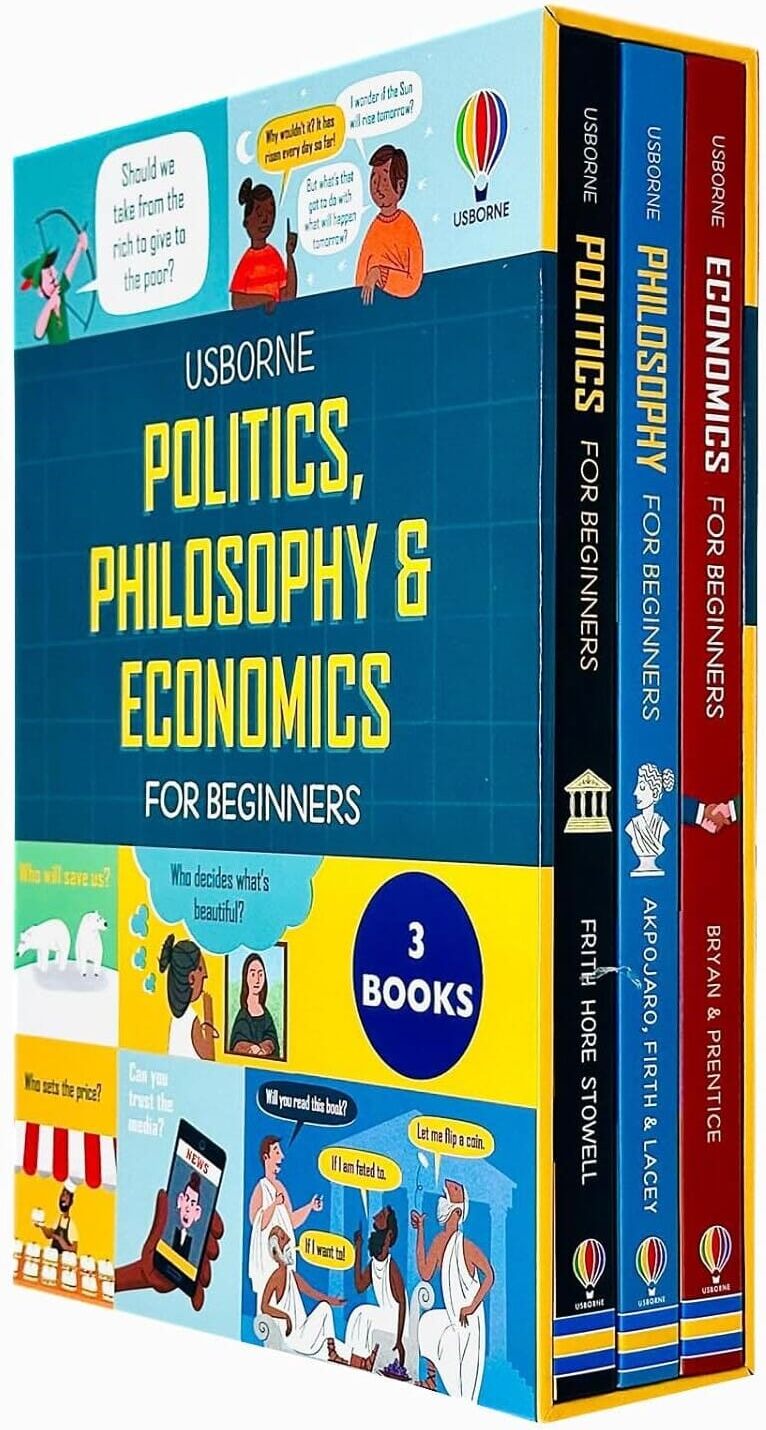
Usborne For Beginners Series: Politics, Philosophy and Economics 3 Books Collection Box Set - Ages 11+ - Hardback Usborne Publishing LtdTitles in this set: 1. Politics for Beginners 2. Philosophy for Beginners 3. Economics for Beginners Politics for Beginners An informative guide to political systems, elections, voting and government, and issues including feminism, human rights, freedom of speech and fake news, all explained with clear text and bright, infographic-style illustrations. Includes tips on how to argue and debate, a glossary, and links to specially selected websites with more information. Philosophy for Beginners Philosophy is a way of thinking about just about anything. It asks big questions, such as "how can I be good?" or "what makes something beautiful?" Using lively examples, humorous illustrations and simple thought experiments, this book opens up the world of philosophy to both children and adults and includes links to recommended websites with videos, games and activities to find out more. Economics for Beginners Nobody has everything they need, all the time - so how can we make do with what we have? Economics is all about understanding the choices we make to solve this problem. With bright, infographics pictures, this informative book describes why markets are so important, how businesses work out what to sell, and how governments choose how to run a country. Includes Usborne Quicklinks to specially selected websites for more information.14,95 £*Shipping: 2,99 £Secure redirect to the provider
-
Usborne Big Subjects for Beginners 5 Books Collection Box Set Money, Economics, Business, Politics & Philosophy – Illustrated Educational Learning GHelp children understand the world around them with the Usborne Big Subjects for Beginners – 5 Books Collection Box Set, a beautifully illustrated introduction to some of the most important topics in modern life. Each book breaks down complex ideas into simple, engaging explanations perfect for kids, beginners, and curious young minds.Packed with colourful diagrams, friendly illustrations, quick facts, and clear examples, this set helps young readers explore big ideas with confidence. This educational collection includes: Money for Beginners – Understanding money, saving, spending, and how currency works. Economics for Beginners – Supply, demand, trade, markets, and how economies function. Business for Beginners – How businesses start, operate, grow, and succeed. Politics for Beginners – Governments, elections, laws, democracy, and world politics explained. Philosophy for Beginners – Big questions about life, knowledge, ethics, and thinking skills. Perfect for ages 9–14, home learning, school topics, and young readers who love discovering new knowledge. Related Tags: Usborne, Usbourne Books19,99 £*Shipping: 2,99 £Secure redirect to the provider
-
What is inertia in physics?
In physics, inertia is the tendency of an object to resist changes in its state of motion. This means that an object at rest will stay at rest, and an object in motion will continue moving at a constant velocity unless acted upon by an external force. Inertia is a fundamental property of matter and is described by Newton's First Law of Motion. **
-
Is there inertia in space?
Yes, there is inertia in space. Inertia is the tendency of an object to resist changes in its motion, whether that motion is at rest or in constant motion. In space, objects still possess mass and therefore still exhibit inertia. This means that objects in space will continue to move in a straight line at a constant speed unless acted upon by an external force, in accordance with Newton's first law of motion. **
-
What is the inertia principle?
The inertia principle, also known as Newton's first law of motion, states that an object at rest will remain at rest, and an object in motion will remain in motion with a constant velocity, unless acted upon by an external force. In other words, an object will not change its state of motion unless a force is applied to it. This principle is fundamental to our understanding of how objects move and interact with each other in the physical world. **
-
What are examples of inertia?
Examples of inertia include a stationary object remaining at rest until a force is applied to it, a moving object continuing in a straight line at a constant speed unless acted upon by a force, and a spinning top maintaining its rotational motion unless an external force is applied to change its direction. Inertia is also evident in the difficulty of starting or stopping a moving object, such as a car or a train, due to the resistance of the object to changes in its state of motion. **
* All prices are inclusive of VAT and, if applicable, plus shipping costs. The offer information is based on the details provided by the respective shop and is updated through automated processes. Real-time updates do not occur, so deviations can occur in individual cases. ** Note: Parts of this content were created by AI.