Buy jean-lucdehaene.eu ?
We are moving the project
jean-lucdehaene.eu .
Are you interested in purchasing the domain
jean-lucdehaene.eu ?
domain@kv-gmbh.de · 0541-91531010
Buy jean-lucdehaene.eu ?
How is the IUPAC name determined?
The IUPAC name of a compound is determined by following a set of rules established by the International Union of Pure and Applied Chemistry (IUPAC). These rules consider the structure and composition of the compound, and prioritize certain functional groups and substituents to determine the root name of the compound. The name is then modified with prefixes, suffixes, and numerical locants to indicate the specific arrangement and bonding of atoms within the compound. The goal of the IUPAC naming system is to provide a standardized and systematic way of naming chemical compounds to ensure clarity and consistency in communication within the scientific community. **
Do you know the IUPAC name?
Yes, IUPAC (International Union of Pure and Applied Chemistry) names are systematic names given to chemical compounds based on a set of rules established by the IUPAC. These names are used to uniquely identify and describe the structure of a compound, regardless of language or region. IUPAC names are important in the field of chemistry as they provide a standardized way to communicate about chemical compounds. **


Similar search terms for IUPAC
Top-Angebote
Products related to IUPAC:
-
Banbo Sockers Jeremy Doku Belgium 20cm Fully Articulated FigurineThe Doku Fully Articulated Figurine is a premium collectible designed with precision and authenticity. Measuring 20cm in height, this miniature figure reflects the highest standards of craftsmanship, offering full articulation for dynamic posing. Each figurine is presented in an official Belgium kit and includes a club-branded football, reinforcing its status as an officially licensed product. This collectible is a tribute to Jeremy Doku's legacy and is an essential item for serious football memorabilia collectors. - 20cm premium collectible figure - Full articulation for dynamic posing - Officially licensed, official kit - Includes club-branded football - Great gift for collectors and fans20,49 £*Shipping: 0,00 £Secure redirect to the provider
-
The Little Book of Economics (DK Big Ideas Series)This book is the perfect introduction to the subject of economics and economic ideas through history. From the earliest forms of currency to the Industrial Revolution, and from the birth of the stock market to free-market capitalism and globalized trade, The Little Book of Economics brings economic theory and the work of key economists to life. Journeying through centuries of economic thought, it is the perfect pocket-sized guide to the subject. Packed with infographics and flowcharts that explain complex concepts clearly and simply, The Little Book of Economics offers you a combination of clear text and hard-working infographics in a portable format that is perfect for reading on the go.5,99 £*Shipping: 2,99 £Secure redirect to the provider
-
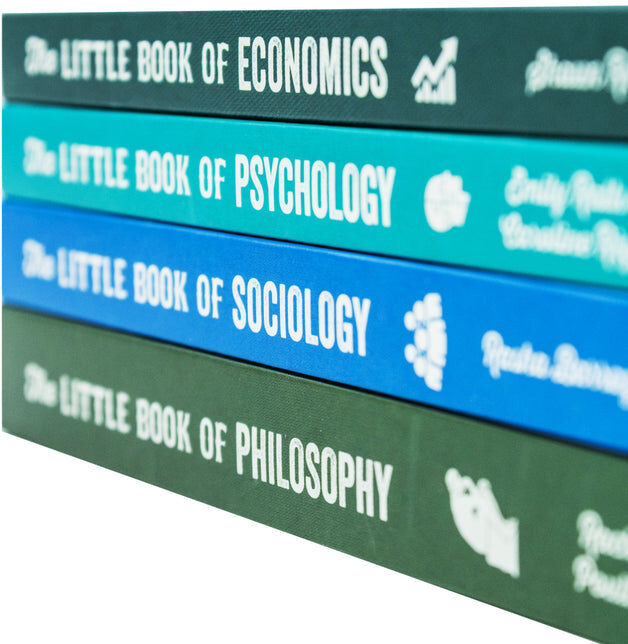
Summersdale Publishers The Little Book of Philosophy, Sociology, Economics & Psychology 4 Books Collection SetThe Little Book of Philosophy Philosophy is a quest for wisdom and knowledge; philosophia in Ancient Greek literally means “love of wisdom”. The aim of philosophy is to ask and explore life’s big questions to help us work out what we can know and how we can live a good life. Today, in a world of fake news, embarking on a quest for truth couldn’t be more important. The Little Book of Sociology From the smallest everyday interaction to the impact of vast systemic change, societies are brimming with fascinating phenomena we all want to understand more clearly.There's never been a more important moment to grasp what's going on around us, and this pocket-sized guide offers an engaging introduction to the key sociological concepts. The Little Book of Economics This Book will bring you up to speed on the basics of micro- and macroeconomics and demystify the world of taxes, trade, investments and finance, in simple English and with easy-to-follow examples.By the end of this crash course, you will have a grasp on all the essential terms, concepts and theories you need to know to understand modern-day. The Little Book of Psychology If you want to know your Freud from your Jung and your Milgram from your Maslow, strap in for this whirlwind tour of the highlights of psychology. Including accessible primers on: - The early thinkers who contributed to psychological ideas and the birth of modern psychology- Famous (and often controversial) experiments and their repercussions.12,99 £*Shipping: 2,99 £Secure redirect to the provider


-
What are the following IUPAC nomenclatures?
1. IUPAC nomenclature for organic compounds: This is a set of rules and guidelines used to name organic compounds systematically, based on the structure and composition of the molecule. It ensures that each compound has a unique and unambiguous name, making it easier to communicate and study. 2. IUPAC nomenclature for inorganic compounds: Similar to organic compounds, this system provides a systematic way to name inorganic compounds based on their composition and structure. It helps to distinguish between different compounds and allows for easier communication and study of inorganic chemistry. 3. IUPAC nomenclature for coordination compounds: This system is used to name coordination compounds, which consist of a central metal ion bonded to ligands. The naming is based on the type and number of ligands, as well as the oxidation state of the metal ion, ensuring a clear and consistent naming system for these complex compounds. **
-
What is the IUPAC name of perchlorate?
The IUPAC name of perchlorate is tetrachloratooxidane. **
-
What is the IUPAC name for this halogenalkane?
The IUPAC name for the given halogenalkane is 1-chloro-3-methylbutane. This name is derived from the longest carbon chain in the molecule, which contains four carbon atoms. The chlorine atom is located on the first carbon of the chain, and there is a methyl group attached to the third carbon. Therefore, the complete IUPAC name for this compound is 1-chloro-3-methylbutane. **
-
What is the IUPAC name for citric acid?
The IUPAC name for citric acid is 2-hydroxypropane-1,2,3-tricarboxylic acid. This name reflects the chemical structure of citric acid, which contains three carboxylic acid groups and a hydroxyl group. The IUPAC name is used to systematically name organic compounds based on their chemical structure, providing a standardized way to identify and communicate about different molecules. **


Are there different versions of the IUPAC nomenclature?
Yes, there are different versions of the IUPAC nomenclature. The IUPAC regularly updates and revises its nomenclature rules to reflect new discoveries and developments in chemistry. These updates ensure that the nomenclature remains consistent and accurate across different areas of chemistry. Additionally, there may be specific nomenclature guidelines for different types of compounds, such as organic compounds, inorganic compounds, and polymers. **
How are compounds named according to IUPAC rules?
Compounds are named according to IUPAC (International Union of Pure and Applied Chemistry) rules by identifying the longest carbon chain in the molecule and determining the functional groups present. The name begins with the prefix indicating the number of carbon atoms in the longest chain, followed by the root of the name indicating the type of carbon-carbon bond present. Then, the functional groups are named and assigned a position number based on their location on the carbon chain. Finally, any substituent groups are named and assigned a position number, and the names are all combined in a specific order to form the complete IUPAC name of the compound. **
Top-Angebote
Products related to IUPAC:
-
Banbo Tielemans Belgium Fully Articulated FigurineThe Tielemans Fully Articulated Figurine is a premium collectible designed with precision and authenticity. Measuring 20cm in height, this miniature figure reflects the highest standards of craftsmanship, offering full articulation for dynamic posing. Each figurine is presented in an official Belgium kit and includes a club-branded football, reinforcing its status as an officially licensed product. This collectible is a tribute to Youri Tielemans's legacy and is an essential item for serious football memorabilia collectors. - 20cm premium collectible figure - Full articulation for dynamic posing - Officially licensed, official kit - Includes club-branded football - Great gift for collectors and fans20,49 £*Shipping: 0,00 £Secure redirect to the provider
-
Banbo De Bruyne Belgium Fully Articulated FigurineStanding 20cm tall in his Belgium national team kit, this Banbo De Bruyne figurine captures one of football’s most complete midfielders in red, complete with articulation at the shoulders, hips, and neck for dynamic pose options. Whether displayed on a shelf or featured mid-celebration, every detail - from the authentic uniform to the realistic facial sculpting - reflects the precision expected from officially licensed sports merchandise. Football collectors and Belgium supporters will find this figurine equally suited to display and imaginative play. Each comes with an official team-branded football accessory, making it a self-contained collectors’ piece that pairs well with other players in the Banbo range, sold separately. • Multi-Point Articulation: Fully posable at the shoulders, hips, and neck for celebration poses and dynamic display angles. • Authentic Team Kit: Sculpted in Belgium’s official national team uniform with precise sponsor and kit detailing. • Included Football Accessory: Comes with an official Belgium team-branded football to complete the collectors’ display. • Realistic Facial Likeness: Hand-sculpted and painted to capture De Bruyne’s distinctive features with impressive accuracy. • Officially Licensed: An authorised merchandise product with full international licensing compliance. • Collector-Friendly Scale: At 20cm tall, sized perfectly for display on shelves, desks, or in fan collections alongside other figurines.20,49 £*Shipping: 0,00 £Secure redirect to the provider
-
Banbo Sockers Jeremy Doku Belgium 20cm Fully Articulated FigurineThe Doku Fully Articulated Figurine is a premium collectible designed with precision and authenticity. Measuring 20cm in height, this miniature figure reflects the highest standards of craftsmanship, offering full articulation for dynamic posing. Each figurine is presented in an official Belgium kit and includes a club-branded football, reinforcing its status as an officially licensed product. This collectible is a tribute to Jeremy Doku's legacy and is an essential item for serious football memorabilia collectors. - 20cm premium collectible figure - Full articulation for dynamic posing - Officially licensed, official kit - Includes club-branded football - Great gift for collectors and fans20,49 £*Shipping: 0,00 £Secure redirect to the provider
-
The Little Book of Economics (DK Big Ideas Series)This book is the perfect introduction to the subject of economics and economic ideas through history. From the earliest forms of currency to the Industrial Revolution, and from the birth of the stock market to free-market capitalism and globalized trade, The Little Book of Economics brings economic theory and the work of key economists to life. Journeying through centuries of economic thought, it is the perfect pocket-sized guide to the subject. Packed with infographics and flowcharts that explain complex concepts clearly and simply, The Little Book of Economics offers you a combination of clear text and hard-working infographics in a portable format that is perfect for reading on the go.5,99 £*Shipping: 2,99 £Secure redirect to the provider
-
How is the IUPAC name determined?
The IUPAC name of a compound is determined by following a set of rules established by the International Union of Pure and Applied Chemistry (IUPAC). These rules consider the structure and composition of the compound, and prioritize certain functional groups and substituents to determine the root name of the compound. The name is then modified with prefixes, suffixes, and numerical locants to indicate the specific arrangement and bonding of atoms within the compound. The goal of the IUPAC naming system is to provide a standardized and systematic way of naming chemical compounds to ensure clarity and consistency in communication within the scientific community. **
-
Do you know the IUPAC name?
Yes, IUPAC (International Union of Pure and Applied Chemistry) names are systematic names given to chemical compounds based on a set of rules established by the IUPAC. These names are used to uniquely identify and describe the structure of a compound, regardless of language or region. IUPAC names are important in the field of chemistry as they provide a standardized way to communicate about chemical compounds. **
-
What are the following IUPAC nomenclatures?
1. IUPAC nomenclature for organic compounds: This is a set of rules and guidelines used to name organic compounds systematically, based on the structure and composition of the molecule. It ensures that each compound has a unique and unambiguous name, making it easier to communicate and study. 2. IUPAC nomenclature for inorganic compounds: Similar to organic compounds, this system provides a systematic way to name inorganic compounds based on their composition and structure. It helps to distinguish between different compounds and allows for easier communication and study of inorganic chemistry. 3. IUPAC nomenclature for coordination compounds: This system is used to name coordination compounds, which consist of a central metal ion bonded to ligands. The naming is based on the type and number of ligands, as well as the oxidation state of the metal ion, ensuring a clear and consistent naming system for these complex compounds. **
-
What is the IUPAC name of perchlorate?
The IUPAC name of perchlorate is tetrachloratooxidane. **
Similar search terms for IUPAC
-
Summersdale Publishers The Little Book of Philosophy, Sociology, Economics & Psychology 4 Books Collection SetThe Little Book of Philosophy Philosophy is a quest for wisdom and knowledge; philosophia in Ancient Greek literally means “love of wisdom”. The aim of philosophy is to ask and explore life’s big questions to help us work out what we can know and how we can live a good life. Today, in a world of fake news, embarking on a quest for truth couldn’t be more important. The Little Book of Sociology From the smallest everyday interaction to the impact of vast systemic change, societies are brimming with fascinating phenomena we all want to understand more clearly.There's never been a more important moment to grasp what's going on around us, and this pocket-sized guide offers an engaging introduction to the key sociological concepts. The Little Book of Economics This Book will bring you up to speed on the basics of micro- and macroeconomics and demystify the world of taxes, trade, investments and finance, in simple English and with easy-to-follow examples.By the end of this crash course, you will have a grasp on all the essential terms, concepts and theories you need to know to understand modern-day. The Little Book of Psychology If you want to know your Freud from your Jung and your Milgram from your Maslow, strap in for this whirlwind tour of the highlights of psychology. Including accessible primers on: - The early thinkers who contributed to psychological ideas and the birth of modern psychology- Famous (and often controversial) experiments and their repercussions.12,99 £*Shipping: 2,99 £Secure redirect to the provider
-
DK The Little Book Of Series 6 Books Collection Set (Economics, Politics, Shakespeare, Philosophy, Psychology, History)The Little Book Of Economics From the earliest forms of currency to the Industrial Revolution, and from the birth of the stock market to free-market capitalism and globalized trade, The Little Book of Economics brings economic theory and the work of key economists to life. Journeying through centuries of economic thought, it is the perfect pocket-sized guide to the subject. The Little Book Of Politics From the origins of democracy to Machiavelli's cunning statecraft, and from Rousseau's "social contract" to the American Declaration of Independence, Marxist communism, the dawn of populism, and identity politics, The Little Book of Politics examines the philosophies behind the different political beliefs and methods of government used around the world over the course of human history. The Little Book Of Shakespeare This bold book covers every work, from the comedies of Twelfth Night and As You Like It to the tragedies of Julius Caesar and Hamlet, plus lost plays and less well-known works of poetry. Easy-to-understand graphics and illustrations bring the themes, plots, characters and language of Shakespeare to life, including illustrated timelines which offer an at-a-glance summary of the action for each play. With detailed plot summaries and an in-depth analysis of the major characters and themes, this is a brilliant, innovative exploration of the entire canon of Shakespeare plays, sonnets and poetry. The Little Book Of Philosophy To the complete novice learning about philosophy can be daunting - The Little Book of Philosophy changes all that. With the use of powerful and easy-to-follow images, famous quotations, and explanations that are easily understandable, this book cuts through any misunderstandings to demystify the subject. The Little Book Of Psychology DK's The Little Book of Psychology answers all these questions and provides an insight into this fascinating field of science. Whether you are a student, an expert, a novice, or have a general interest in the human mind, this portable guide is the perfect choice to start exploring and understanding psychology. The Little Book Of History The Little Book of History charts world history from the dawn of civilisation to the modern culture we live in today. From the origins of homo-sapiens to the release of Nelson Mandela, from the French Revolution to the Space Race, The Little Book of History is a stunning exploration of the human timeline up to and including modern Islam, the world wide web, and the global financial crisis.14,99 £*Shipping: 2,99 £Secure redirect to the provider
-
Usborne Big Subjects for Beginners 5 Books Collection Box Set Money, Economics, Business, Politics & Philosophy – Illustrated Educational Learning GHelp children understand the world around them with the Usborne Big Subjects for Beginners – 5 Books Collection Box Set, a beautifully illustrated introduction to some of the most important topics in modern life. Each book breaks down complex ideas into simple, engaging explanations perfect for kids, beginners, and curious young minds.Packed with colourful diagrams, friendly illustrations, quick facts, and clear examples, this set helps young readers explore big ideas with confidence. This educational collection includes: Money for Beginners – Understanding money, saving, spending, and how currency works. Economics for Beginners – Supply, demand, trade, markets, and how economies function. Business for Beginners – How businesses start, operate, grow, and succeed. Politics for Beginners – Governments, elections, laws, democracy, and world politics explained. Philosophy for Beginners – Big questions about life, knowledge, ethics, and thinking skills. Perfect for ages 9–14, home learning, school topics, and young readers who love discovering new knowledge. Related Tags: Usborne, Usbourne Books19,99 £*Shipping: 2,99 £Secure redirect to the provider
-
What is the IUPAC name for this halogenalkane?
The IUPAC name for the given halogenalkane is 1-chloro-3-methylbutane. This name is derived from the longest carbon chain in the molecule, which contains four carbon atoms. The chlorine atom is located on the first carbon of the chain, and there is a methyl group attached to the third carbon. Therefore, the complete IUPAC name for this compound is 1-chloro-3-methylbutane. **
-
What is the IUPAC name for citric acid?
The IUPAC name for citric acid is 2-hydroxypropane-1,2,3-tricarboxylic acid. This name reflects the chemical structure of citric acid, which contains three carboxylic acid groups and a hydroxyl group. The IUPAC name is used to systematically name organic compounds based on their chemical structure, providing a standardized way to identify and communicate about different molecules. **
-
Are there different versions of the IUPAC nomenclature?
Yes, there are different versions of the IUPAC nomenclature. The IUPAC regularly updates and revises its nomenclature rules to reflect new discoveries and developments in chemistry. These updates ensure that the nomenclature remains consistent and accurate across different areas of chemistry. Additionally, there may be specific nomenclature guidelines for different types of compounds, such as organic compounds, inorganic compounds, and polymers. **
-
How are compounds named according to IUPAC rules?
Compounds are named according to IUPAC (International Union of Pure and Applied Chemistry) rules by identifying the longest carbon chain in the molecule and determining the functional groups present. The name begins with the prefix indicating the number of carbon atoms in the longest chain, followed by the root of the name indicating the type of carbon-carbon bond present. Then, the functional groups are named and assigned a position number based on their location on the carbon chain. Finally, any substituent groups are named and assigned a position number, and the names are all combined in a specific order to form the complete IUPAC name of the compound. **
* All prices are inclusive of VAT and, if applicable, plus shipping costs. The offer information is based on the details provided by the respective shop and is updated through automated processes. Real-time updates do not occur, so deviations can occur in individual cases. ** Note: Parts of this content were created by AI.